BlackballingTimTebow

  • Subscribe to our RSS feed.
  • Twitter
  • StumbleUpon
  • Reddit
  • Facebook
  • Digg
Showing posts with label rabbis. Show all posts

Friday, 9 August 2013

Free Download of the Soncino Talmud in English Online at Halakhah.com: 25,000+ satisfied customers a month

Posted on 14:09 by Unknown
The Soncino Babylonian Talmud English translation is online - at a site that is not anti-Semitic or polemical.

Download the Talmud in English free at http://www.halakhah.com/ - 25,000+ downloads each month! 300,000+ each year.

TRANSLATED INTO ENGLISH WITH NOTES, GLOSSARY AND INDICES UNDER THE EDITORSHIP OF RABBI DR. I. EPSTEIN B.A., Ph.D., D. Lit. FOREWORD BY THE VERY REV. THE LATE CHIEF RABBI DR. J. H. HERTZ. INTRODUCTION BY THE EDITOR. THE SONCINO PRESS, LONDON.

Contains the Sedarim (orders, or major divisions) and tractates (books) of the Babylonian Talmud, as translated and organized for publication by the Soncino Press in 1935 - 1948.

The site has the entire Soncino Talmud edition in PDF format and  about 8050 pages on line in browser compatible HTML format, comprising 1460 files — of the Soncino Talmud.

Please add a link to the site http://www.halakhah.com on your web site or blog.

Highlights:
  • A newly formatted 2-column PDF version of the Soncino Talmud at Halakhah.com.
  • A Kindle edition of the Soncino Talmud available from Amazon.com: The Kindle Soncino Talmud in English


Read More
Posted in amazon, antiSemitism, bloggers, book club, books, dead-sea-scrolls, hebrew, history, Is-it-kosher?, israel, kindle, rabbis, religion, talmud, women, yeshiva | No comments

Friday, 2 August 2013

JStandard: My Dear Rabbi Talmudic Advice Column for August

Posted on 07:23 by Unknown
Published in the Jewish Standard, Dear Rabbi: Your Talmudic advice column

Dear Rabbi,

My son, his wife and children have decided to make aliyah to Israel. My husband and I understand their practical and idealistic motivations for this decision. We applaud what they are doing and feel pride in their Judaic and Zionist ardor. We plan to visit them in Israel periodically, but we have no plans to move there.

At times we both admit to ourselves that we worry about them and that we will sorely miss them. What advice can you give us to help us cope with this bittersweet situation that we face?

Stuck in Bergen County
New Milford

Dear Stuck,

First, know that you are not alone. In our area, a good number of Modern Orthodox families with young children make aliyah. An underlying motive for this uprooting is the financial burden of local day school tuition. That concern combines with years of sincere devotion to the Zionist dream. Modern Orthodox education encourages pride in the miracle of the State of Israel. And many Jews simply feel a mystical attachment to the Land of Israel.

When younger couples and single college age children decide to make aliyah, that move is logistically less complex. But it also leaves parents with long distance communications challenges and airplane trips to see their offspring.

Many of our area families boast three generations of dedicated Zionists. I recall the excitement in our family when I was a young child and my grandparents announced they were making aliyah. That event took place way before such moves became more common among American Jews, when living in Israel meant making sacrifices and accepting a lower standard of living, even hardships.

Based on what I know from experience and from friends and what I sense in your inquiry, I don’t entertain the notion that you try to dissuade your children from going. Yet there are several ways to reduce the anxiety and loneliness that you fear.

First, do the travel. It’s been said for decades about the situation of American Jews, “There is no galut if you commute.” You are not fully in the exile if you make enough periodic visits to Israel. And you will feel close to your children and grandchildren as you see them progress and grow at intervals.

Next, use the technology. When my grandparents went to live in Israel, plain old telephones were a rarity and long distance calls were expensive and low-quality. Nowadays, even with the time differential, you can vividly see and interact with your Israeli family via Internet video applications such as Skype and FaceTime. Voice phone calls cost little or nothing.

Third, try to form informal social support mechanisms. You can make efforts to connect to other nearby parents and grandparents whose children have made aliyah to share concerns and, of course, to keep abreast of the best airfares and apps to use for the suggestions above.

Last, you can heed your children, when they inevitably suggest to you that you join them in their adventures, and you can make aliyah yourselves.

Dear Rabbi,

After many years of regular worship I started to pay more attention to the Alenu prayer that we recite at the end of every service. I do not understand why we say this so frequently and at the end of each synagogue session. Also, I have become uncomfortable with what I feel is the confrontational tone of the prayer and its proclamation that we are the only true faith and all other gods are worthless and powerless.

Can you help me find renewed relevant meaning in this regular recitation?

Pluralistic, not Pugilistic
Teaneck

Dear Pluralistic,

Your question draws attention to one of the great complexities of our prayer book – the different moods and motivations that flow throughout our services. One of those distinct philosophies, succinctly expressed in the Alenu, is that we are in constant competition with other faiths, that there will be an end to the contest of history, and that there will be only one winner – us.

In religious terms we refer to the “last minutes of the game” as the messianic age, the time at which we will emerge from the battles of the ages and the all the world will recognize us as the worthy people who worship the one true God.

In the services in the synagogue this theme comes to the forefront at particular times. The Alenu is famously one of the crucial liturgies in the Musaf additional service of Rosh Hashanah in the section of the Amidah that we call Malchiyot – kingship. We enthrone God on the New Year as our sovereign and we initiate our declarations of that with the Alenu.

The prayer concludes, “And the Lord shall be king over all the earth: in that day shall the Lord be One, and his name One.”

Most of the rest of the year, and throughout our prayers, we allow other themes to dominate at the core of our services. I suspect with reasonable certainty that we are not yet at the end of time. But permit me to offer this metaphor to help explain why it makes sense to me that we conclude every service before we leave the synagogue with the not-really-inclusive, and actually somewhat combative, Alenu prayer.

I see our synagogue as our team’s locker room where we gather together at our half-time breaks. We share our diverse team talk there for a while. And when we are done, right before we go outside onto the field to resume the contest and competition in the arena of our communities, we engage in a spirited spiritual pep-talk.

We say team-like things: that we are number-one, that our God is number one, and that we will crush our opponents! In the theological language of our prayer that comes out: “We therefore hope in you, O Lord our God, that we may speedily behold the glory of your might, when you will remove the abominations from the earth, and the idols will be utterly cut off, when the world will be perfected under the kingdom of the Almighty, and all the children of flesh will call upon your name…”

Whether you see yourself as an active team player or as an avid spectator, you should be able to root heartily for your team, the Jewish People, and do so with the Alenu prayer.

Dear Rabbi,

What does it mean when you say you offer in your column “Talmudic Advice”?

Seeking answers
Fort Lee

Dear Seeking,

By saying I supply Talmudic advice I mean that I offer in my column advice only, and not halakhic rulings or decisions. And I also mean that in Talmudic fashion I try to see more than one dimension of an issue and encourage the questioner to find his or her own best solution.

The Dear Rabbi column offers timely advice based on timeless Talmudic wisdom. It aspires to be equally respectful and meaningful to all varieties and denominations of Judaism. You can find it here on the first Friday of the month. Send your questions to DearRabbi@jewishmediagroup.com

Groove with God's Favorite Prayers
Read More
Posted in archetypes, israel, prayer, rabbis, religion, synagogues, talmud | No comments

Thursday, 25 July 2013

Is Basketball Without Yarmulkas Kosher?

Posted on 08:13 by Unknown
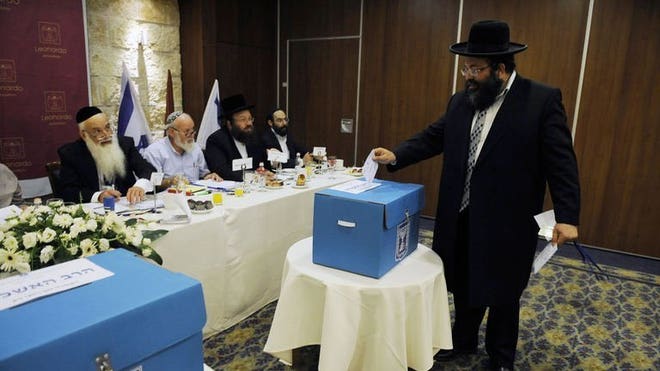
In a post called, "Chief Rabbis, Basketball and Tolerance," blogger Andrew Griffel in Ops and Blogs in  The Times of Israel argues as follows.

Once upon a time long long ago Rabbi Soloveitchik told MTA orthodox high school students that they could play in Madison Square Garden with or without wearing their yarmulkas and tsitsis. It was up to them.

The chief rabbis in Israel are not as tolerant as Rabbi Soloveitchik. Therefore the chief rabbinate ought to be abolished.

We agree with the conclusion, if not with the non-linear logic of the post. And now that the office of chief rabbi has turned 100% nepotistic, the end of the institution is just around the corner. See Israel elects new chief rabbis.

Finally, consider this remarkable video of orthodox couples who are marrying in Israel outside of the regulation of the rabbinate - חתונה בלי הרבנות - הוויה - טקס ישראלי‬‎.


כתבה ביומן בערוץ 1 ביום שישי, על זוגות שמעצבים את טקס החתונה בעצמם בלי הרבנות
עוד על חתונה יהודית בלי הרבנות באתר הוויה
www.havaya.info
Read More
Posted in israel, orthodox, rabbis, rav, soloveitchik, sports | No comments

Tuesday, 23 July 2013

Times' Frank Bruni on the Tragic Yeshiva University Sex-Abuse Scandals

Posted on 10:00 by Unknown
There's not much I can add to this op-ed except for this. When Bruni asked Yeshiva University Rabbis Hershel Schachter and Norman Lamm for comments, he reports, "Schachter, ...didn’t respond to my request Monday for comment. Neither did Rabbi Lamm."

Both of these men continue to claim "true character" and "true leadership." Schachter likes to be called a Gadol - a great man. And yet how sad that given a chance to show character and leadership, neither of them had anything at all to say to the Times about these tragic matters.
The Faithful’s Failings
By FRANK BRUNI

The men were spiritual leaders, held up before the children around them as wise and righteous and right. So they had special access to those kids. Special sway.

And when they exploited it by sexually abusing the children, according to civil and criminal cases from different places and periods, they were protected by their lofty stations and by the caretakers of their faith. The children’s accusations were met with skepticism. The community of the faithful either couldn’t believe what had happened or didn’t want it exposed to public view: why give outsiders a fresh cause to be critical? So the unpleasantness was hushed up.

This is not a column about the Catholic Church.

This is a column about Orthodox Jews, who have recently had similar misdeeds exposed, similar cover-ups revealed.

And I’m writing it, yes, because the Catholic Church over the last two decades has absorbed the bulk of journalistic attention, my own included, in terms of child sexual abuse. There are compelling reasons that’s been so: Catholicism has more than one billion nominal adherents worldwide; endows its clerics with a degree of mysticism that many other denominations don’t; and is just centralized enough for scattered cover-ups to coalesce into something more like a conspiracy. The pattern of criminality and evasion has been staggering.

But some of the same dynamics that fed the crisis in Catholicism — an aloof patriarchy, an insularity verging on superiority, a disinclination to get secular officials involved — exist elsewhere. And the way they’ve played out in Orthodox Judaism illustrates anew that religion isn’t always the higher ground and safer harbor it purports to be. It can also be a self-preserving haven for wrongdoing.

Early this month, 19 former students of the Yeshiva University High School for Boys in Manhattan filed a lawsuit alleging sexual abuse by two rabbis in the 1970s and 1980s who continued to work there even after molestation complaints. The rabbis were also allowed to move on to new employment without ever being held accountable. School administrators, the lawsuit alleges, elected not to report anything to the police.

Rabbi Norman Lamm, the president of Yeshiva at the time, admitted as much in an interview with The Jewish Daily Forward. He said that when accusations against a faculty member were “an open-and-shut case,” he’d let the accused person “go quietly.”

Back then there was less alarm about, and understanding of, child molestation, he said. Back then he was also steering Yeshiva through grave financial hardship. A sex-abuse scandal wouldn’t have been a great fund-raising tool.

“The school made the conscious and craven decision to protect its reputation,” Kevin Mulhearn, the lawyer representing the plaintiffs, told me Monday.

Is such a defensive mind-set really a relic of a less enlightened past? Earlier this year a prominent scholar at Yeshiva University, Rabbi Hershel Schachter, was caught on audiotape at a conference in London telling Orthodox leaders that Jewish communities should set up their own review boards to evaluate any complaints of child sexual abuse and determine whether to bother with the police. This contradicts state laws on mandatory reporting for teachers, counselors, physicians and such.

Schachter further discouraged police involvement by warning that accused abusers could wind up “in a cell together with a shvartze, in a cell with a Muslim, a black Muslim who wants to kill all the Jews.” Shvartze is a harshly derogatory racial term. Yeshiva University condemned the remarks but seemingly didn’t discipline Schachter, who didn’t respond to my request Monday for comment. Neither did Rabbi Lamm.

Rabbi Schachter’s aversion to law enforcement isn’t isolated. The ultra-Orthodox group Agudath Israel of America has taken the position that observant Jews should get a green light from a rabbi before notifying police about suspected molestation. It’s precisely this sort of internal policing that the Catholic Church did so disastrously, leaving abusers unpunished and children in harm’s way.

Ultra-Orthodox Jews in particular have prioritized their image and independence over justice. They have shunned Jews who took accusations outside their communities; in fact, Charles Hynes, the Brooklyn district attorney, has cited that as a reason for minimizing publicity around child sexual abuse cases among Orthodox Jews. But over the weekend he changed tacks and gave The New York Post the names of some 40 convicted people.

Community intimidation is why 17 of the 19 plaintiffs in the Yeshiva case are identified only as John Doe, said Mulhearn, their lawyer, who mentioned another insidious wrinkle reminiscent of Catholic cases.

One of the abusers, he said, used religion itself to muffle a few abused boys. The rabbi allegedly invoked the Holocaust, which their parents had survived, telling the boys not to cause mom or dad any more suffering with a public stink.

Talmudic Books
Talmud in English
Ponder the Questions of Whence and Wherefore
Experience God's Favorite Prayers
Read More
Posted in gay rights, norman lamm, orthodox, rabbis, schachter, universities, yeshiva | No comments

Monday, 22 July 2013

Is the Chief Rabbi of Israel Kosher?

Posted on 15:22 by Unknown
No, the chief rabbi of Israel is not kosher.

Increasingly Israelis are growing tired of their failed institution of the Chief Rabbi. The Times reports on the chief rabbi selection process -- regarding David Stav "currently the rabbi of Shoham" -- "Promising ‘Real Revolution,’ Israeli Jolts Race for Chief Rabbi" that the nuclear option is on the table - namely the dissolution of the institution of chief rabbi.
...All of which has made many here question the very need for the chief rabbinate, an institution with roots in the 17th-century Ottoman era that was formalized by the British in 1921. Once revered as a platform for intellectual and spiritual leadership, the $5.6 million operation, whose chiefs are paid $100,000 a year, has lately been dismissed as an anachronistic patronage farm rife with corruption.

Judaism is famously nonhierarchical, with individual rabbis worldwide having authority to interpret Jewish law for their congregations or communities, but the rabbinate and its religious courts are the only legal authorities here on family law and kosher food.

As many as one-third of Israeli couples marry abroad or live together without marrying rather than follow the rabbinate’s strictures. Jewish law requires that the husband agree to divorce, and about 3,400 women a year are denied dissolution of their marriages. Hundreds of thousands of Israelis, mostly Russian immigrants and their children, are barred from marriage and adoption because they cannot adequately prove their Jew identity; only conversions conducted by rabbinate-authorized rabbis are accepted.

“This institution has to be abolished for the sake of religion, and for the sake of the state,” said Moshe Halbertal, a professor of Jewish philosophy at Hebrew University. “Israel’s identity as a Jewish state has other much more essential components than legislating Judaism.”
We concur and observe that the crooked cannot be made straight -- the Israeli chief rabbinate is not kosher -- it should be dissolved.
Read More
Posted in Is-it-kosher?, israel, rabbis | No comments

Friday, 19 July 2013

Is the Dot-Kosher Internet Domain Extension Kosher?

Posted on 14:15 by Unknown
Some rabbis say yes; other rabbis say no.

Here's a both ironic and Talmudic kosher story to end your week from Bloomberg ("It’s Rabbi Versus Rabbi in $17 Billion Dot-Kosher Battle"). "The Internet’s organizing body, called Icann, is meeting this week in the South African port city of Durban to begin a major expansion of domain names. That may include a decision on who can operate and license “dot-kosher” as a suffix for Web addresses, the same way “dot-com” and “dot-net” are used."

When rabbis engage in a dispute like this one, well that's Talmudic:
Five organizations have banded together to oppose the sole applicant for dot-kosher, Kosher Marketing Assets, saying it seeks to profit from a sacred tradition that shouldn’t be over-commercialized. The two sides, which both are in the business of certifying food as kosher, are at odds over how Internet users will find such products in the future.
And when rabbis say obviously silly things, well that's ironic:
“We think that if the term ‘kosher,’ which has important meaning in the Jewish religion, is commercialized, it will do a disservice to how religion in general should be treated and will harm the kosher public specifically,” said Harvey Blitz, the Kashruth Commission chairman of the Union of Orthodox Jewish Congregations of America, one of the five groups. The New York-based organization oversees OU Kosher, the world’s largest certification agency.
Ironic here because there is no question that Kosher certification agencies have already commercialized kosher supervision.

We sure hope these rabbis work this domain dispute out.
Kosher Marketing Assets is a unit of OK Kosher Certification, a Brooklyn, New York-based competitor to OU Kosher. Rabbi Don Yoel Levy, OK Kosher’s CEO, said he never intended to control the potential domain name unilaterally and said he was open to working with the five groups -- the Orthodox Union, STAR-K Kosher Certification Inc., Chicago Rabbinical Council Inc., the Kashruth Council of Canada, and Kosher Supervision Service Inc., better known as the KOF-K.
ADS
Talmudic Books
Kindle Talmud in English
Ponder the Questions of Whence and Wherefore
Experience God's Favorite Prayers
Read More
Posted in Is-it-kosher?, kosher, money, rabbis | No comments

Wednesday, 17 July 2013

Are personal lubricants kosher?

Posted on 10:57 by Unknown
The Guardian reported ("Kosher lube puts oral sex on the menu for Orthodox Jews") that yes, now some personal lubricants are kosher.
The US-made Wet range of lubes now has eight lines that have been given a religious stamp of approval, including its "Ecstasy" product. This means that rabbis from the Rabbinical Council of California have inspected Wet's 52,000 sq ft production plant and researched the origins of every ingredient to check none comes from items prohibited by kosher rules...

For hundreds of years the Jewish religious establishment has been divided on whether oral sex is allowed as part of a bedroom repertoire; it's still pretty taboo for public discourse – and the rabbis who have approved the lubes haven't spelled out whom their certification will benefit. ...this is the first rabbinic innovation to help kosher oral sex. In eight flavours.
Don't know where the Guardian gets its "divided" information. Maybe from British rabbis.
Read More
Posted in Is-it-kosher?, rabbis, women | No comments

Monday, 15 July 2013

The Parable of the Rabbi Who Thinks He's a Cop

Posted on 06:40 by Unknown
New York Magazine has and article that seems to me to be a perfect parable (Beware the Bipolar Rabbi Trying to Pull Over City Drivers by Delia Paunescu).

Actual news story that serves as a parable:

It seems impersonating a police officer isn’t just a recent problem in Queens. As the Associated Press discovered, it’s been a busy summer for Alfredo Borodowski, a city rabbi who’s suspected of trying to pull over other drivers who raise his ire by cutting him off or generally driving too slowly. Though Borodowski has only been arrested once for using a “Triborough Bridge and Tunnel Authority Officer 1338” badge — one authorities have called “totally fake” and which you can see in action here — the rabbi may have been behind at least two other cases around New York City going as far back as April.

PR consultant Peter Moses recognized the rabbi on the local news and realized he’d had a similar interaction with Borodowski between Scarsdale and White Plains:
"He's shouting, 'I'm a police officer, pull over' and he's got this little badge that he's waving at us. I told my wife, 'That's not a police officer.’ Then he's out of his car and he's screaming, 'I can arrest you! I can have you arrested!' I said, 'Fine, call the police,' then he storms back to his car and drives off."

While Borodowski was reportedly fired from his position at Manhattan’s Temple Emanu-El, he remains on staff at Congregation Sulam Yaakov in Larchmont, which said of their rabbi, "No comment. That's his personal life."

Moses added that he and his wife, who was present during the attempted pull-over back in May, want “the rabbi to get the emotional help he so obviously needs.” On that note, Borodowski’s lawyer acknowledged the rabbi's "manic" behavior, for which he has previously been hospitalized, saying that his client suffers from bipolar disorder and is expected to plead not guilty in court this week.

Interpretation:

Lately we've noticed that more than one rabbi thinks he's a cop. In fact, as we all know, Rabbis are supposed to be teachers, not cops. Moses' response to the manic rabbi is emblematic of how a person should respond to any rabbi who steps out of his proper professional role.
Read More
Posted in humor, rabbis | No comments

Monday, 8 July 2013

Rabbi Dr. Zev Zahavy Photos

Posted on 08:15 by Unknown
Photos
Rabbi Dr. Zev Zahavy

New York City 
September 8, 1918 - May 1, 2012

Nine Minute Slideshow
edited by Barak

Sermons - View Online
Sermons - Download PDF
edited by Tzvee

Donate in Memory of Zev Zahavy
Read More
Posted in rabbis, universities, yeshiva, zev zahavy, zichron ephraim, zionism | No comments

Tuesday, 2 July 2013

Summer Sale -- We Reduced Prices on Our Talmudic Books

Posted on 06:50 by Unknown
Summer Sale. Wow. Our Talmudic Kindle Book Prices are Reduced!

Kosher Talmud: Hullin $.99

God's Favorite Prayers $2.99

Define Judaism: Ten Seminars $2.99

God Bless You: The Origins of Jewish Prayers and Blessings $2.99

Eleazar: Rabbi, Priest, Patriarch $2.99

Kosher Prayers: Talmud Yerushalmi Berakhot $2.99

Rashi: The Greatest Exegete $.99

Six People You Meet in Synagogue $.99

Whence and Wherefore $2.99
Read More
Posted in bible, book club, books, Holocaust, kabbalah, kaddish, meditation, money, politics, prayer, rabbis, religion, synagogues, talmud, Talmudic Books, universities, yeshiva, zionism | No comments

Sunday, 30 June 2013

Without Wearing Neckties, Israeli Jewish adults attending synagogue 'happy and healthier'

Posted on 12:29 by Unknown
Even though the ordinary Israeli who attends synagogue does not even own a necktie, a social scientist has "proven" that "Israeli Jewish adults attending synagogue 'happy and healthier'"

In fact the researcher involved already knew the answers before he even conducted his "studies." Professor Jeff Levin has spent his career "proving" the health benefits of religion for the world. There is zero chance at this stage of the game that he would come up with a conclusion to disprove his base assumptions.

We are shocked by this discovery though for a specific reason. We've been criticized for discussing in our "Dear Rabbi" column a rule requiring tie-wearing by Jews in a local synagogue if they want to receive a Torah-honor on Sabbaths and Holidays.

Here's a nugget from a letter to the editor of the Jewish Standard that fervently defends the wonderful meaning of the tie-wearing practice by Dr. Reuben Gross:
Rabbi Zahavy takes a strong stand with the congregant. He labels the shul’s dress code as “nonsense.” This is hardly appropriate language coming from a rabbi about a shul’s policy, which follows the dictates of no less a person than the prophet Ezra (6th century BCE), who enacted the rule that individuals should give special “kavod” (honor) to the Sabbath, marked by their change of clothing.
Truly we did not know that Ezra the Scribe (usually not called prophet) knew about neckties in the 6th century BCE.

And so we wonder how Jews in Israel who attend shul regularly can be happier and healthier even though they do not own or wear ties.

Or let's be positive here. Can you imagine just how happy and healthy these synagogue attenders would be in Israel if they wore neckties?

Perhaps we can start a new program to promote even greater health and happiness in Israel: Neckties Without Borders for Religious Sabras.

Here is a news report on the impressive research on the health benefits of attending synagogue:
Israeli Jewish adults, who go to synagogue regularly, pray often, and think of themselves as religious are much healthier and happier than their non-religious counterparts, two new studies have suggested.

Baylor University researcher Jeff Levin, Ph.D, said that commitment to Jewish religious belief and practice is strongly associated with greater physical and psychological well-being.

One study used 2010 data on 1,849 Jewish adults from the Israeli sample of the European Social Survey and has been published in Psychology of Religion and Spirituality, an official journal of the American Psychological Association.

The other study used 2009-10 data on 991 Jewish adults from the Israeli sample of the International Social Survey Programme's Religion III survey and has been published in the Journal of Happiness Studies. (ANI)
Rabbi Neckties

Read More
Posted in bible, health, humor, israel, rabbis, science, synagogues, universities | No comments

Jewish Times: Are Hebrew National Hot Dogs Really Kosher?

Posted on 04:16 by Unknown
Yes. Hebrew National Hot Dogs have been kosher since 1905.

We eat them. But we know lots of more-kosher-than-thou types who don't partake. Those are the Jewish folk who answer to an even "higher authority" than Hebrew National.

Kenneth Lasson, writing in a Baltimore Jewish Times cover story in 2009, weaves together reportage about the hot dog industry, the kashrut supervision industry and baseball parks to come up with a fascinating fabric of a story, "Hebrew National and Kosher Politics - What’s kosher about answering to a higher authority?".

For years there have been some super-glatt-orthodox who whisper about whether the supervision of Hebrew National was "reliable." Lasson covers this controversy and says for instance,
...As to Triangle K, Rabbi Abadi wrote on the kashrut.org Web site, “Rabbi Ralbag is a G-d-fearing man and if he says it’s kosher, you sure can eat it. I can’t say the same for many of the other labels out there.”...more...
The Talmudic question is of course, can we trust the writing of Kenneth Lasson. Is he reliable? Is he glatt kosher? /repost from 7-9-09/

Kosher Talmud: Babylonian Talmud Hullin
Read More
Posted in baseball, Is-it-kosher?, kosher, money, orthodox, rabbis, sports | No comments

Sunday, 23 June 2013

Non-Congratulations to the New Non-Rabbis

Posted on 19:09 by Unknown
Thirty years ago, in 1983 we were happy to start sending our women Jewish Studies major graduates at the University of Minnesota to train to become rabbis in the Reform movement. We told them to go out and become full head rabbis of synagogues, not assistants or educational directors. Some did. We were proud.

This week we read of the non-ordination of three females by an Orthodox institute. We sadly shake our heads and dejectedly shrug our shoulders. This is a milestone of non-progress.

This non-event is a rare mixture of chutzpah and cowardice on the part of these women and their teachers. Their mentors dared to give a "degree" and "title" to the women and yet they fearfully refrained from ordaining them with the accepted titles "rabbis" or the feminine of the term, "rabbahs" to be more grammatical.

All of this is too perplexing for our Talmudic CPU to process. Our Talmudic processing system has short-circuited and crashed and cannot analyze this conflicted non-event any further.

Hence we can at best non-extend our non-congratulations to the new women non-rabbis.  We heartily offer our non-applause to them on their non-ordinations.What a bewildering religion.

Here is the story from JTA.
(JTA) — Yeshivat Maharat, which trains Orthodox Jewish women to be religious leaders, held its first graduation ceremony.

Ruth Balinsky Friedman, Rachel Kohl Feingold and Abby Brown Schier graduated Sunday in a ceremony in New York City attended by some 500 people.
The graduates are set to work for Orthodox synagogues and institutions.

Maharat is a Hebrew acronym for Manhiga Hilkhatit Rukhanit Toranit, or leader in legal, spiritual and Torah matters.

Each graduate of the New York yeshiva will use the title of maharat rather than rabbi or rabba — the title given to Sarah Hurwitz, the dean of Yeshivat Maharat, when she was ordained by Rabbi Avi Weiss.

The movement to confer religious authority on women in the Orthodox community, which began in 2009, remains controversial in the Orthodox community.

Last month, the Rabbinical Council of America reissued a 2010 statement that said, “We cannot accept either the ordination of women or the recognition of women as members of the Orthodox rabbinate, regardless of the title.”

Check Out 44 Talmudic Books
See the 36 Volume Kindle Talmud in English
Ponder the Questions of Whence and Wherefore
Experience God's Favorite Prayers
Read More
Posted in orthodox, rabbis, synagogues, women | No comments

Thursday, 13 June 2013

Is John Oliver Jewish?

Posted on 16:18 by Unknown
John Oliver is filling in for Jon Stewart this summer, 2013. He is one funny dude.

The Daily Show with Jon Stewart
Get More: Daily Show Full Episodes,Indecision Political Humor,The Daily Show on Facebook


On 2/6/2011 we wrote:

We laughed out loud at the latest video clip that the Jewish Humor Central Blog posted (hat tip) from the Daily Show's John Oliver.

And then we thought, he is so funny, yes, John Oliver is Jewish. (But he isn't.)

We base our conclusion in particular on his ability to invent a new Jewish holiday for the purposes of celebrating a political victory in Texas as you will see in the hilarious clip below.

The Daily Show With Jon StewartMon - Thurs 11p / 10c
Jewish Speaker of Texas State House
www.thedailyshow.com
Daily Show Full EpisodesPolitical Humor & Satire Blog</a>The Daily Show on Facebook
Read More
Posted in are-they-jewish?, christianity, humor, politics, rabbis, wingnuts | No comments

Saturday, 1 June 2013

Discover Mindful Jewish Meditation

Posted on 19:47 by Unknown
The benefits of Jewish meditation are accessible to every type of Jew through acts of Jewish piety.

People tend to think that the Orthodox and Hasidic Jews are really pious, the Conservative Jews less so, and the Reform and Reconstructionist even less.

Not so. Piety is individual. You decide how pious you wish to be. Some may argue that the Liberal Jew who makes a decision to engage in piety every day is more pious than the Orthodox Jew who rarely pauses to decide for himself what endows his structured life with meaning.

If you want it to, piety can fill your life as a Jew and endow it with transcendent meaning. Piety can overshadow faith at the central defining core of your Judaism. You can bring it into your daily, weekly and annual routines, and life cycle events.

"Mindful" is a term made popular by meditation guru, Jon Kabat-Zinn and others through their writings and teachings. They brought the concept into Western life from its origins within Eastern cultures. These teachers instruct us to meditate on the here-and-now. As if this was some new idea to us in the West. Done properly, religious practice affords us this mindfulness constantly in any number of ways.

We describe some elements of the religion of the Talmudic rabbis. If this is a form of Judaism that fulfills your needs, go with it! If not, we suggest you discover and then extract the major concepts of classical Judaic practice and apply them to your circumstances. In that way you will develop mindful piety for yourself, for your community and your calendar.

The Judaic Roots of Mindful Piety

Long ago rabbis prescribed, for example, that each Jew recite one hundred blessings each day. The recitation of a blessing prior to the performance of many basic rituals helped make a Jew mindful of his every action.
R. Meir used to say, "There is no man in Israel who does not perform one hundred commandments each day [and recite over them one hundred blessings] . . . And there is no man in Israel who is not surrounded by [reminders of the] commandments. [Every person wears] phylacteries on his head, phylacteries on his arm, has a mezuzah on his door post and four fringes on his garment around him . . . [Tosefta Berakhot 6:24-25]."
From the first stirring every morning, the mindful Jew began his day with acts of religious significance.

Waking up: Washing hands upon arising took on a special meaning. The individual conducted the washing according to a simple but prescribed practice. Water had to be poured on the fingers of each hand up to the joint as specified by the masters.

Bodily functions like elimination are not ordinarily considered in the realm of religious ritual. Yet the rabbis of old said that one had to recite a blessing after that normally profane physical process as thanks for continued health.

And speaking words of wisdom, Praying. In rabbinic Judaism morning prayers were literally clothed in piety. Often they took place in a special spot. And of course, they were repeated regularly.

Dressing for prayer: The man put on the tallith (prayer shawl) and tefillin (phylacteries) while reciting the respective blessings. Each pious male obtained and maintained these prized and essential objects of piety in accord with the prescriptions of the rabbis and scribes. The man wore these objects to show compliance with the prescriptions of the verses of the Torah recited in the shema (Deut. 6:4-9, 11:13-21 and especially Num. 15:37-41). Each knot on the four fringes of the tallith garment was tied in accord with age-old tradition.

The tefillin were crafted of select leather, made into cubical containers to hold the small parchments of biblical paragraphs written by trained scribes. The head-tefillin had to rest on the worshiper between the eyes on the forehead, neither too high on the head, nor too low on the face. The leather strap that held it in place had to be tied in accord with known custom. The wearer understood that the knot of leather that sat at the base of his skull was a representation of the letter yod, the third letter of Shaddai, one of the divine names.

On the leather box of the arm-tefillin was inscribed the letter shin. The wearer knew that the knot that held it fast on his left biceps--opposite his heart--was a form of the letter dalet. Thus as he recited prayer, the Jew was bound head and heart to God, Shaddai. He wore these appurtenances each weekday from the time he reached 13, the age of maturity, the age of Bar Mitzvah. Obtaining a pair of tefillin from the scribe was the most significant overt sign of achieving adult membership in the rabbinic community.

The standard practice was to wear the tallith and tefillin during the morning prayers and then remove them. To show extreme piety some few virtuoso rabbis wore them all day as they sat immersed in the study of Torah.

Congregating for prayer: An ordinary Jewish man could recite his prayers in a designated synagogue or study hall, in private, at home, or in any orderly place. For optimal piety he went to the synagogue to pray with the minyan, the prayer quorum of ten adult Jews. The formalization of the synagogue as a standard communal institution took place over a span from the first century through the middle ages. The emphasis in Jewish custom and law was always on prayer in a public gathering of ten or more men, not on prayer in a specified building or designated place for gathering. This aspect of rabbinic piety was thus defined mainly in terms of a societal association with a community of other Jews. The rabbis placed little emphasis on the need for sacred bricks and mortar to fulfill the spiritual needs of prayer.

Repeating the process: Rabbinic piety centered on stability and repetition. On weekdays Jews gathered for the morning, afternoon and evening prayers. Major elements of prayer were repeated with small variations at the three services. A person said the shema in the morning and evening services; the amidah (standing prayer of eighteen blessings) in the morning afternoon and evening services; the alenu (a sublime prayer proclaiming God king) to conclude all three.

To these they added a morning Torah service to the public prayer on Monday and Thursday and on any festival or fast day. For this part of the service they read the first section of the seven of the Torah weekly portion that was going to be read during the Sabbath morning service at the end of the workweek. This focused attention on the coming Sabbath celebration and gave the men gathered during the week an added opportunity to hear the inspiration of the words of Torah.

During the week a fourth service, the additional prayers, called musaf, were added to celebrate special days. On New moons, celebrants added several paragraphs to the regular services and read an appropriate passage from the Torah. They concluded the morning prayers with the recitation of the amidah the standing prayer of eighteen blessings -- of the additional service. Likewise on holidays, modifications were made in the regular prayers and the additional musaf amidah was appended.

Evening prayers consisted of the shema, amidah and alenu. A widespread custom was to recite the shema once more at bedtime. Many believed this added evocation of piety would also protect the person who recited it from harm during the night.

The Mindful Challenge

Simply put the challenge is how do we take these traditions and making them over into a template for our own lives? Rabbis often tell us their answer. However, deep Piety, especially mindful piety, cannot come from the outside.

How do we find meaning through study and reflection and make all this into our own piety? No one should presume to tell us that, though many will. But that must be our own - our most personal task. (Repost)
Read More
Posted in buddhism, hasidism, kabbalah, meditation, orthodox, prayer, rabbis, religion | No comments

Friday, 31 May 2013

Dear Rabbi Controversy on Angels and Prayers

Posted on 09:51 by Unknown
Here are this week's Dear Rabbi Responses and Discussions from the Jewish Standard.

Rabbi Zahavy’s response to my letter of May 23 ("Kaddish, Kedushah and Angels") concerning the efficacy of the Kaddish and the meaning of the Kedushah, is both confusing and incomplete. On the one hand he admits that our prayers, specifically the Kaddish, do not cause God to act regarding the souls of our departed and then immediately contradicts that by writing that God hears and answers his prayers (meaning the Kaddish and/or the El Maleh Rachamim) regarding the immortality of his parents' souls. He also completely ignores my question about why, in the Kedushah, does the Creator of the Universe need to hear words of praise from beings (angels who have no free will) who have no choice in the matter.

Perhaps Rabbi Zahavy can further clarify. Thank you.

Jeff Bernstein
New Milford

Jeff Bernstein, in his May 24 letter, asserts that “we are rewarded and/or punished for our own deeds and not for what anyone else does. My parents’ place in the World to Come does not depend in the least on what I or anyone does on their behalf.” In actuality, while Mr. Bernstein’s first sentence is accurate, his second sentence does not follow from the first, and is not correct.

When we conduct ourselves in a good and holy way, do good deeds, and yes, say Kaddish for our parents, we demonstrate that our parents were successful in passing Jewish ideals to their children. It is our demonstration of their merit that confirms and raises their place in the World to Come, not what we do on their behalf. In other words, the very fact of our desire to honor our parents by saying Kaddish for them is a sign of their good work in raising their children. And conversely, our neglect or unwillingness to say Kaddish would be a sign of their failure.

So yes, the place in Olam HaBah of Mr. Bernstein’s parents depends strictly on their own deeds; and Mr. Bernstein’s actions in this world are a clear demonstration of his parents’ deeds, at least in the area of child raising and fulfilling the mitzvah of teaching one’s children.

Leon Sutton
New York, NY

Dear Rabbi, Rabbi Dr. Tzvee Zahavy, responds:

My intent in my column is to encourage an open, non-denominational and non-judgmental discussion of basic Judaic issues. So I am grateful for the Talmudic questions from Mr. Bernstein and Mr. Sutton. Both writers take prayers seriously and they raise legitimate concerns. 

I wish I could give Mr. Bernstein a clearer description of how prayer affects God’s decisions. Our great philosophers and theologians agree on the one hand that our prayer does not force God to act. Belief that prayer compels God would be a heresy that equates prayer with magic. Yet our great minds are equally sure that God hears our prayers and takes them into account in determining our fate. Note well that the members of our congregations may have personal beliefs on this matter that are not based on our official theology or philosophy but are to them equally valid and meaningful.

On the second question, the idea that angels sing praises to God is biblical, as for example in Psalm 148. I confess to a lack of further expertise in matters between God and his angels.

Mr. Sutton’s meaningful and personal theological explanations remind me once again that ordained Rabbis do not have an exclusive franchise on our theology. Members of the community at large can be a great source of creative insights.

Please continue to write in to Dear Rabbi and agree or disagree. I look forward to reading more of your questions, insights and challenges.

Talmudic Books
God's Favorite Prayers
Read More
Posted in prayer, rabbis, synagogues, teaneck | No comments

Saturday, 25 May 2013

jStandard: Aramaic and Angels Redux

Posted on 18:24 by Unknown
May 24, 2013
To the Editor:

Rabbi Zahavy’s column about kaddish (“Dear Rabbi,” May 3 Jewish Standard) and the letter responding to it (“Do the angels pray in Aramaic?,” May 10 Jewish Standard) raise a host of issues that must be dealt with rationally.

When my parents died, I, as an Orthodox Jew, said kaddish three times daily for 11 months for both. I did it out of respect for Jewish law and tradition and respect for them. Certainly not because I expected that my actions or inactions in this world would have any effect on their position vis-a-vis God in the World To Come. Rabbi Zahavy says that “to secure a place for the departed soul”… “many Jews believe” that by daily recitation of Kaddish, you will be “certain” about the departed’s immortal life “in the eternity of heaven.”

To begin with, our religion makes very clear that we are rewarded and/or punished for our own deeds and not for what anyone else does. My parents’ place in the World to Come does not depend in the least on what I or anyone does on their behalf.

Secondly, both he and the letter writer, Israel Polak, discuss whether angels do or do not communicate in Aramaic! One of my problems, relating to this and the Kedushah, has to do with the issue of angels praising God. It is established that 1) angels have no free will and 2) God has no need of our prayers nor of our praise of Him. We are the ones who need to pray and to praise God. Why then does the Creator of the Universe need to hear, as the Talmud states, the Kedushah illustrates, and Rabbi Zahavy argues, words of praise from beings who have no choice in the matter?

While it may be comforting and romantic to believe, as Rabbi Zahavy says “many Jews” do, that we can intercede with God “to gain heavenly immortality for the soul of a departed one,” it makes no sense that our intercession will, as it were, cause God to change His mind.

Jeff Bernstein
New Milford

Rabbi Dr. Tzvee Zahavy, replies:

Mr. Bernstein makes good points. I agree that we always must offer respectful performances of our ritual. And surely we do not expect our prayers will compel God to act. But my explorations seek to understand why we say this Aramaic or Hebrew prayer in this place and for this amount of time.

I do believe that God hears my fervent and humble prayers and that they do make a difference. That is why, during Yizkor on the second day of Shavuot, I said the El Maleh Rachamim, asking God to grant proper rest in heaven for the dear souls of my father and my mother, “O God, full of mercy, Who dwells on high, grant proper rest on the wings of the Divine Presence in the lofty levels of the holy and the pure ones, who shine like the glow of the firmament…”

Experience God's Favorite Prayers
Read More
Posted in kaddish, prayer, rabbis, religion, synagogues, teaneck | No comments

Friday, 24 May 2013

Imagine the Day that Religions Mellowed Out

Posted on 09:36 by Unknown
Imagine the Day that Religions Mellowed Out.

Wait. Three reasons that it looks like that happened.

1. The Pope said that atheists are okay too. "Atheists and other nonbelievers largely welcomed Wednesday's (May 22) remarks by Pope Francis that performing "good works" is not the exclusive domain of people of faith, but rather a place where they and atheists could and should meet."

Mellow pope - but what about the "bad" priests?

2. The Lubavitcher Hasidim reached out to hipsters - because they have beards too (Times): "...on Tuesday night, at Chabad of North Brooklyn, the Lubavitcher outpost on Bedford Avenue in Williamsburg, there was a forum, advertised on fliers up and down the boutique-lined strip, on the theme 'Hasid and hipster, not as different as you think.' ...But perhaps the difference is significant enough. Maybe it was the lack of Pabst Blue Ribbon beer (or alcohol at all) or special brewed coffee (there was plenty of instant), but the attendance of bearded hipsters was sparse, and possibly nonexistent."

Mellow Hasids - but no Hipster love connections.

3. And other Orthodox Jews (sorta) accept into their communities gays and Sabbath violators too ("Inclusivism: First Among Equals?"): "R. Ettlinger, for example, allowed the wine of Jews who publicly violated Shabbat by suggesting they could be categorized as tinnokot she-nishbu, people raised outside of Jewish values, who therefore could not be fully blamed for their transgressions."

Mellow rabbis - can't blame secular Jews - they were brainwashed as children (tinnokot she-nishbu) into being secular. Oh wait maybe it was the rabbis who were brainwashed. No that could not be. Never mind.
Read More
Posted in christianity, hasidism, humor, orthodox, rabbis, religion | No comments

Thursday, 23 May 2013

Video: Rabbi Goren in 1967 at the Western Wall in Jerusalem

Posted on 10:35 by Unknown
Rabbi Shlomo Goren blowing the shofar and praying at the Western Wall in 1967 was one of the greatest and most inspired moments in Jewish history. Here is the video...


[Repost from 2010.]
Read More
Posted in israel, rabbis, videos, zionism | No comments

Friday, 10 May 2013

JStandard: Do Angels Speak Aramaic?

Posted on 14:48 by Unknown
My Dear Rabbi column (May 3) sparked an urgent letter to the editor at the Jewish Standard. I answered it.
The Dear Rabbi Column, “ ...based on timeless Talmudic wisdom” (May 3), writes the following about the Kaddish: “Yet this prayer is especially apropos for a mourner because we believe that it is the Aramaic praise that the angels recite in God’s presence in the heavens.”

1.The Talmud (Shabbos 12 A) states that the angels do not understand and certainly do not communicate in Aramaic.

2.The prophets, Isaiah 6 and Ezekiel 3, inform us of the praises that the angels recite to God, verses that are incorporated in the daily prayers as the Kedusha, not the Kaddish.

3.The rabbis have explained that the unique quality of the Kaddish, which elevates it even beyond the Kedusha ( Berachos 21 B), derives from the fact that it is the result of human initiative.

Israel Polak
Teaneck

Dear Rabbi, aka Rabbi Dr. Tzvee Zahavy, replies:

I thank Mr. Polak for his letter. My column targets the issues of people, not of angels. Since I have not yet been to heaven, I can only speculate on the language skills of angels and their activities based on the assertions of our traditions. The Talmud passage Mr. Polak refers to cites the individual view of one rabbi regarding the language skills of angels. Other authoritative rabbis in the Talmud and later times argue that some angels do know Aramaic or that the question is moot, because angels know what you are thinking. Putting the language and angel issues aside, I do agree, as I proposed in my column, that the Kaddish is a powerful prayer of praise, a “human initiative” that mourners recite here on earth to act as if they are intercessors to gain heavenly immortality for the soul of a departed loved one.
Check Out 45 Talmudic Books
See the 36 Volume Kindle Talmud in English
Ponder the Questions of Whence and Wherefore
Experience God's Favorite Prayers
Read More
Posted in humor, kaddish, rabbis, talmud | No comments
Older Posts Home
Subscribe to: Posts (Atom)

Popular Posts

  • Thanksgiving Turkey Drumstick Jack-O-Lantern Pumpkin Pie Table Song - A Lone Pumpkin Grew
    Thanksgiving will be upon us soon and we sing traditional holiday songs at our Thanksgiving dinner. Here are the words to one of our favorit...
  • Is Paul Volcker Jewish?
    No, we do not think that former Federal Reserve Chairman Paul Volcker is a Jew. According to reporter Roni Sofer of the usually reliable Is...
  • Is Carlos Slim Helú Jewish?
    No, Carlos Slim Helú is not a Jew. He is of Lebanese origins and a Maronite Catholic by religion. This Mexican businessman and philanthropis...
  • Is Sigourney Weaver Jewish?
    Now it is far-fetched that anybody would think that actress Sigourney Weaver is Jewish. No, Sigourney Weaver is not a Jew. The tall actress ...
  • Is Caroline Kennedy's Husband Edwin Schlossberg Jewish?
    Yes, Edwin Arthur Schlossberg is a Jew. All four of Schlossberg's grandparents were Russian (Ukranian) Jews born near Poltava and arrive...
  • Update on the Insults: A Battle Over a Book: Haym Soloveitchik v. Talya Fishman
    Our once-upon-a-time teacher at Yeshiva University has panned a new book about rabbinic cultural development. It's a veritable battle ov...
  • Free Download of the Soncino Talmud in English Online at Halakhah.com: 25,000+ satisfied customers a month
    The Soncino Babylonian Talmud English translation is online - at a site that is not anti-Semitic or polemical. Download the Talmud in Englis...
  • Is Marissa Mayer Jewish?
    Yes, the new CEO of Yahoo!, Marissa Mayer is a Jew. Hat tip to our friend David who points out, "I find it interesting that Google, Fac...
  • Note to Self: Do not wear Geox shoes in the rain or snow. They have little holes in soles!
    We wear Geox shoes almost all the time nowadays. They are truly more comfortable for someone like us who mainly sits at a desk throughout th...
  • Rav Soloveitchik's Dissertation at the University of Berlin
    In honor of the 20th yahrzeit of the Rav's passing (on Hol HaMoed Pesach, the 18th of Nisan, in 1993) and of the 110th year since his bi...

Categories

  • 9/11 (1)
  • Alan F. Segal (1)
  • amazon (33)
  • antiSemitism (14)
  • apocalyptic (1)
  • apple (11)
  • archetypes (35)
  • are-they-jewish? (73)
  • ariely (1)
  • art (18)
  • atlantic beach (3)
  • audio book (1)
  • barack (20)
  • baseball (2)
  • beyond belief (1)
  • bible (48)
  • bloggers (12)
  • bobby knight (1)
  • book club (3)
  • book serialization (14)
  • books (83)
  • boteach (2)
  • brooklyn (10)
  • buddhism (5)
  • christianity (59)
  • circumcision (3)
  • copyright (4)
  • daf yomi (4)
  • daphne (1)
  • dead-sea-scrolls (4)
  • dirty tricks (4)
  • egalitarianism (3)
  • einstein (2)
  • film (20)
  • footnote (2)
  • gay rights (12)
  • golf (8)
  • google (15)
  • haaretz (5)
  • haggadah (9)
  • Harvard (1)
  • hasidism (17)
  • health (36)
  • heath (1)
  • hebrew (18)
  • history (12)
  • Holocaust (18)
  • huckabee (1)
  • hullin (3)
  • humor (76)
  • inventions (30)
  • iPad (12)
  • iPhone (9)
  • Is-it-kosher? (46)
  • islam (19)
  • israel (108)
  • juergensmeyer (2)
  • kabbalah (12)
  • kaddish (6)
  • kindle (33)
  • kosher (16)
  • kugel (1)
  • kushner (1)
  • laptops (1)
  • lex talionis (1)
  • madoff (15)
  • madonna (4)
  • Maimonides (5)
  • meditation (22)
  • menorah (2)
  • Merkin (10)
  • microsoft (1)
  • Minnesota (8)
  • Mishnah (2)
  • money (65)
  • mormons (5)
  • morton smith (3)
  • music (29)
  • nazis (3)
  • netanyahu (1)
  • New York Jews (46)
  • norman lamm (5)
  • obama (19)
  • orthodox (86)
  • Passover (20)
  • politics (91)
  • pools (13)
  • prayer (92)
  • Purim (9)
  • rabbis (124)
  • rahm emanuel (1)
  • rav (15)
  • recipes (2)
  • religion (170)
  • schachter (1)
  • science (45)
  • shaiel (1)
  • sikhs (3)
  • smoking (2)
  • software (6)
  • soloveitchik (17)
  • soul (2)
  • sports (47)
  • statins (1)
  • supreme court (1)
  • Surfing (1)
  • synagogues (73)
  • talmud (117)
  • Talmudic Books (30)
  • teaneck (37)
  • terrorism (6)
  • texas (1)
  • Thanksgiving (4)
  • theodicy (1)
  • tim tebow (3)
  • universities (56)
  • videos (19)
  • wikipedia (1)
  • wine (3)
  • wingnuts (22)
  • women (64)
  • yeshiva (41)
  • yiddish (5)
  • youkilis (2)
  • zev zahavy (21)
  • zichron ephraim (12)
  • zionism (21)

Blog Archive

  • ▼  2013 (187)
    • ▼  August (5)
      • Free Download of the Soncino Talmud in English Onl...
      • Selichot are Not Outcries
      • Is Google NOW incredible or creepy? Is NOW kosher?
      • Is Israel's National bird the Hoopoe - Duchifat - ...
      • JStandard: My Dear Rabbi Talmudic Advice Column fo...
    • ►  July (30)
    • ►  June (23)
    • ►  May (25)
    • ►  April (30)
    • ►  March (33)
    • ►  February (17)
    • ►  January (24)
  • ►  2012 (313)
    • ►  December (31)
    • ►  November (23)
    • ►  October (16)
    • ►  September (15)
    • ►  August (20)
    • ►  July (20)
    • ►  June (34)
    • ►  May (19)
    • ►  April (38)
    • ►  March (39)
    • ►  February (31)
    • ►  January (27)
Powered by Blogger.

About Me

Unknown
View my complete profile