BlackballingTimTebow

  • Subscribe to our RSS feed.
  • Twitter
  • StumbleUpon
  • Reddit
  • Facebook
  • Digg

Saturday, 11 February 2012

Kindle your Daf Yomi Talmud Study for $.99 with the Soncino English Translation of Babylonian Talmud Tractate Temurah

Posted on 16:29 by Unknown
The Soncino Babylonian Talmud tractate Temurah - Kindle Edition is $.99 at Amazon.

The daily study of the Talmud called Daf Yomi starts tractate Temurah on Friday, February 17.

[No Kindle yet? Pick one up at Staples or Target where the touch is $99 this week with a $20 or $10 rebate.]

Babylonian Talmud tractate TEMURAH (Substitution): Sets forth the rules governing the substitution of one offering for another in accordance with the law prescribed in Lev. XXVII, 10. Seven Chapters.

This edition of the classic Soncino English Talmud translation was reformatted by Reuven Brauner.

Brauner's new and excellent Reformatted Soncino Talmud (in PDF) is available free at http://www.halakhah.com/ where it has attracted a record number of hits and downloads.

Get your copy of the new Kindle volume today. Let's make the Talmud a big international best seller.

Updates!
Two more Kindle volumes are available! Kerithoth and Me'ilah


"God's Favorite Prayers" was published by Talmudic Books
Read More
Posted in amazon, bible, inventions, Is-it-kosher?, israel, kindle, rabbis, religion, software, talmud, Talmudic Books | No comments

From Talmudic Books: "Kosher Talmud: Babylonian Talmud Hullin" - live now and available for ordering

Posted on 16:20 by Unknown
Another new Kindle Edition from Talmudic Books: "Kosher Talmud: Babylonian Talmud Hullin" - live for sale now and available for ordering at Amazon.

Description: To know what food is kosher, that is, fit to eat according to rabbinic Judaism, you must study the principles set forth in this volume, the Babylonian Talmud Tractate Hullin. This translation, adheres closely to the text so that the reader has a sense of the structure and balance of the original. Yet at the same time it conveys the flow of the legal arguments and debates, the dramatic unfolding of events in stories, and the sensitivities to words and language in the exegetical texts. Its aim is to facilitate a smooth conversation between readers and the text so that, without consulting the original Hebrew and Aramaic version, they can appreciate the substantive meaning and recognize some major aspects of the style of the Talmudic text.

The free Kindle book sample (Click on: Send sample now) is quite large because the book itself is over 570 pages in print format.

Here is what one scholarly reviewer said at length in praise of the book:
From Ioudaios Review. Reviewed by: Sigrid Peterson, Department of Religious Studies, University of Pennsylvania.
“All may slaughter,” has to be one of the more memorable three-word opening lines ever invented – right up there with “Call me Ishmael.”  While the latter is the opening to Melville’s Moby Dick, the former is less readily identifiable. In fact, the words “All may slaughter” open and form the reiterated recall to the ground theme of Tzvee Zahavy’s modern English translation of Hullin, one of the Tractates of the Babylonian Talmud. On beginning Moby Dick, I am sure I would feel conscientious and obligated and virtuous and bored. Similarly, that was my expectation in opening Hullin on preparing to review it. That expectation has been dispelled by this accessible and fascinating portrayal of the world of the rabbis.
…The critical question in evaluating this work, and Z.’s contribution, is the quality of the translation. I am happy to report that it is an excellent translation. Z. has managed the difficult task of keeping to a literal rendition of the Aramaic and Mishnaic Hebrew of the original, while making excellent sense as one reads the English version alone. Often, translations of rabbinic literature represent paraphrases, and pass along the traditional meaning of a passage. This approach is extremely frustrating to one who is learning the language from an academic point of view, because words and phrases do not always mean, in the translated literature, what they seem to mean lexically. One often has the sense of being tricked.
Zahavy’s translation does not perpetuate this world of special meanings that lack any correspondence with the words of the text. Nevertheless, he translates with full knowledge of those meanings, as a one-time Yeshiva University student under the late R. Soloveitchik, the celebrated posek (decider of difficult questions of Jewish law). Now, however, from his academic vantage point as a professor in the Department of Classical and Near Eastern Studies at the University of Minnesota, Z. has provided the reader with clear English equivalents of the Mishnaic Hebrew and Aramaic of the original, as well as the parenthetical comments that are necessary to translate the laconicities of the original that contribute so much to that sense that understanding the language is never enough.
For example, the Mishnaic Hebrew phrase BO MISTAKEL does have the extended meaning “here is the proof,” and the Soncino edition of the Babylonian Talmud provides that translation. Z., however, translates “Come and take note.” This literal meaning becomes amply clear in the context; it is hard to see why the phrase needed to be given a special meaning over and above the literal translation.
The overall excellence of Z.’s translation gains from such features of Neusner’s approach as the bracketed explanatory concepts which take the place of Soncino’s footnotes. Z. uses these conventions with extraordinary economy and respect for the text and the reader. Z. has mastered the Neusner approach, and as a result the text speaks clearly for itself and the world it portrays.
Zahavy’s choices of American English equivalents are generally excellent; perhaps I was at first taken aback by his use of ‘heretics’ to translate MINIM, the word the Rabbis often used to designate Christians. After some consideration, I found that I agreed with Z.’s choice. The discussion distinguishes between Jewish and Gentile heretics with respect to the validity of their acts of ordinary slaughter (p. 72). I would have found two words, apostate and gentile, understandable in the English, yet I agree with a translation technique that finds the same equivalent for all cases, however odd the concept of Gentile heretic sounds at first.
What is it about Hullin that dispelled my initial sense of obligation, virtue, and boredom? Why do such excellent work as Z.’s, to translate an ordinary collection of rabbinic discussions of minutiae? The answer lies in the content of Hullin. Come and take note.
Hullin means “ordinary slaughter.” It is not until one is well into the discussion that the relationship of the book to its origins in Deut 12:21 is explored. Upon entering the land, all worship was to be in a central location, which meant that sacrificing animals for worship and food could only occur at that place. Until that point in the story, only priests could slaughter; however, priests could be found in a number of local sanctuaries. Now that the cult was to be centralized, there were no local priests to slaughter the meat, offering a portion for sacrifice, keeping a share, and returning most of the meat to the devotee upon some occasion for feasting. Now the rule would become “All may slaughter,” so that outside the designated central place people could still eat meat. The Deut 12:21 passage is cited as follows in this edition…:
R. Yemar said, “The verse says, ‘[If the place which the Lord your God will choose to put his name there is too far from you], then you may kill (ZBHT), any of your herd or your flock, which the Lord your God has given you...]’
I know of no one who has suggested that the intention of Hullin is to encourage vegetarianism. That may well be the effect, however, of reading through easily understandable discussions of the validity of slaughter if the knife is examined afterwards and found to be notched or nicked when the cut was made in a sawing fashion, back and forth. It is a bloody book.
It is in the midst of such discussions, however, following the details of what renders meat TEREFAH, “torn” or fatally damaged in some way that would render the meat carrion, that one learns the fascinating and relevant bit of rabbinic lore that it is not a capital crime to kill someone who is terminally ill, or TEREFAH.
“All may slaughter,” means women as well as men may slaughter; does it mean Samaritans, gentiles, apostates? The Mishna has already qualified the permission somewhat, in saying that the deaf-mute and the idiot and the minor may not slaughter, on the practical grounds of being unlikely to do it properly. However, if supervised, they too may slaughter. The discussions range widely and show some of the best of rabbinic thought, without omitting to display the pickiness of the issues. Yet the first word, “all,” characterizes the attempt at rabbinic inclusiveness.
The portrayal in Hullin of the rabbinic world grappling with the implications of the word “all” is fascinating. A similar discussion of the extent of meaning implied by permitting “all” to do something is found at the beginning of the first volume of b. ‘Arak., 2A-2B. There the Mishna begins “All [persons] are fit to evaluate,” in the Soncino translation, or “All may pledge the Valuation [of others],” in Neusner’s translation… The discussion is confusing, however, and neither translation explains the meaning of what it is the Mishna has permitted “all” to do. Also, the discussion in b. ‘Arak. wanders around, sometimes including women and minors, sometimes excluding one or the other, in a consideration of various other occasions where “all” are permitted to do something. In contrast, “All may slaughter” is a straightforward statement that requires a minimum of social explanation for today’s reader. The discussion that ensues is straightforward enough—by rabbinic standards, that is.
While the initial discussion in Hullin deals with the standard group of deaf-mutes, minors, and imbeciles, who comprise those who are excepted from mishnaic permission to slaughter, women are unequivocally admitted under the wings of the inclusive “all.” Nor does Hullin show a rabbinic discussion that is completely non-sexist, and therefore an inaccurate representation of the rabbinic world. Hullin provides insight into a world that is not hermetically sealed off from reality; that tends to prefer academic points to the close study of animal anatomy; that occasionally takes the world of women for granted; and that has a great deal of investment in determining the ethical way in which humans should proceed – in the specific case of ordinary slaughter of our food, and in the general case of the abstract consideration of “all” and its exclusions.
The discussion in Hullin is simple, clear, and precise. One does not need extensive explanation of rabbinic concepts to understand and follow the discussion. I have begun to imagine using this edition of Hullin as the text for a beginning course in Rabbinic Judaism, and find myself enthusiastic about the prospects. Hullin would also work well as a text for those fascinating courses that are often listed and seldom taught, where some students are reading the original language, and some are reading an English translation.
A Seminar on Christian Origins might look at Hullin in this edition to gain a preliminary understanding of a rabbinic view of Christianity. Since there is also material defining sacred and profane time, as well as grappling with the effects of idolatry and apostasy on the food supply, one might wish to use selections from Hullin in any number of approaches to the academic study of religion(s)…
# 1 Talmudic Books best seller: "God's Favorite Prayers"
Read More
Posted in hullin, Is-it-kosher?, orthodox, rabbis, religion, talmud, Talmudic Books, yeshiva | No comments

Friday, 10 February 2012

WSJ: A rabbi, a priest and a minister walk into an op-ed

Posted on 14:06 by Unknown
The rabbi at the posh KJ synagogue on 85th street has poked his ultra-conservative head into a political fray. Here is the quintessence of how to overstate an opinion, bathing it in the waters of our finding fathers, anointing it with the oils of patriotism. Ahem. Way out of line.
United We Stand for Religious Freedom
ObamaCare's contraception mandate stands the First Amendment on its head.
By DONALD WUERL, CHARLES COLSON AND MEIR Y. SOLOVEICHIK

Stories involving a Catholic, a Protestant and a Jew typically end
with a punch line. We wish that were the case here, but what brings us
together is no laughing matter: the threat now posed by government
policy to that basic human freedom, religious liberty.

Last month the federal Department of Health and Human Services
announced that the Affordable Care Act requires employers to pay for
insurance coverage for abortion-inducing drugs, sterilizations and
contraception. What made the announcement especially troubling is that
HHS specifically declined to exempt religious institutions that serve
those outside their own faiths, such as hospitals and schools.

Coverage of this story has almost invariably been framed as a conflict
between the federal government and the Catholic bishops. Zeroing in on
the word "contraception," many commentators have taken delight in
pointing to surveys about the use of contraceptives among Catholics,
the message being that any infringement of religious freedom involves
an idiosyncratic position that doesn't affect that many people.

Nothing could be further from the truth. The Catholic Church's
teaching on contraception (not to mention abortion and surgical
sterilization) has been clear, consistent and public. HHS Secretary
Kathleen Sebelius's decision would force Catholic institutions either
to violate the moral teachings of the Catholic Church or abandon the
health-care, education and social services they provide the needy.
This is intolerable.

And while most evangelicals take a more permissive view of
contraception, they share with Catholics the moral conviction that the
taking of human life in utero, whether surgically or by abortifacient
drugs, violates the basic human right to life. Evangelical nonprofits
such as Prison Fellowship would therefore also have to choose between
violating their consciences or paying fines that would ultimately
destroy their ability to help the people they are committed to
helping.

Even worse than the financial impact is the breach of faith
represented by Ms. Sebelius's decision. Her notion of an "appropriate
balance" between religious freedom and "increasing access" to
"important preventive services" stands the First Amendment on its
head.

In 1790, George Washington exchanged letters with Moses Seixas, the
warden of the Hebrew Congregation of Newport, R.I. Seixas praised the
newly formed United States for "affording to All liberty of
conscience, and immunities of citizenship." People who knew all too
well what it meant to be deprived of the "invaluable rights of free
Citizens" held religious liberty and freedom of conscience most dear.

In reply, Washington wrote that U.S. citizens had a "right to applaud
themselves" for setting an example of "an enlarged and liberal policy"
that enshrined freedom of conscience. He added that the ability of
members of one faith to seek the benefit of all Americans is the
foundation of America's civic strength.

We see evidence of that strength all around us: If a working mother's
child needs to visit the emergency room, there's a good chance the
hospital is a Catholic one. If an ex-offender needs help readjusting
to life outside of prison, there's a good chance help will come from a
Christian ministry like Prison Fellowship.

Yet instead of encouraging the different faith communities to continue
their vital work for the good of all, the Obama administration is
forcing them to make a choice: serving God and their neighbors
according to the dictates of their respective faiths—or bending the
knee to the dictates of the state.

For Jews, George Washington's letter has always been cherished. It
embodies the promise extended by America not only to them, but to all
citizens. That is why many in the Jewish community are alarmed to see
the very religious freedom Washington praised centuries ago endangered
by Washington's successor. "May the children of the stock of Abraham
who dwell in this land," Washington wrote, "continue to merit and
enjoy the good will of the other inhabitants."

At this critical moment, Americans of every faith, as guardians of
their own freedom, must, in the words of the First Amendment,
"petition the government for the redress of grievances." That's why
over the past two years more than 500,000 people have signed the
"Manhattan Declaration" in defense of religious liberty. They believe,
as do we, that under no circumstances should people of faith violate
their consciences and discard their most cherished religious beliefs
in order to comply with a gravely unjust law.

That's something that this Catholic, this Protestant and this Jew are
in perfect agreement about.

Cardinal Wuerl is the archbishop of Washington, D.C. Mr. Colson is the
founder of Prison Fellowship and the Colson Center for Christian
Worldview. Rabbi Soloveichik is director of the Straus Center for
Torah and Western Thought at Yeshiva University and associate rabbi at
Congregation Kehilath Jeshurun in Manhattan.
Hat tip to Abe, thanks.
Read More
Posted in christianity, politics, rabbis, religion, wingnuts, women | No comments

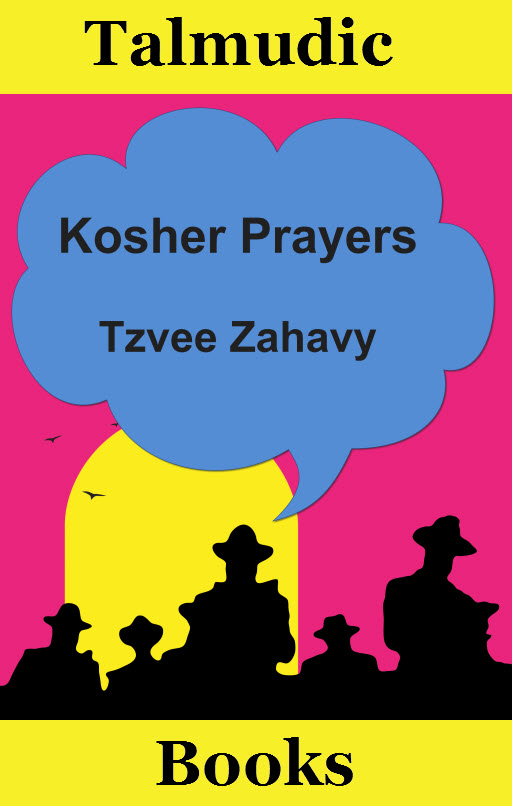
Our new cover for our Kindle ebook "Kosher Prayers"

Posted on 13:44 by Unknown
We happily promote the publication of the new cover of the Kindle Edition of Kosher Prayers, our ebook anthology of texts from the Talmud Yerushalmi Berakhot on the topic of prayer, $4.99.

Friends told us we needed a more distinctive cover. Psst, better buy it quick. We keep raising the price.

And here is a description of the contents: The ancient rabbis had rare wisdom concerning how to talk to God in prayer. The Talmud of Land of Israel in Tractate Berakhot presents many of the ancient rabbis’ discussions about Jewish prayers with particular attention to how to pray the major Jewish prayers, the Shema and the Amidah for the weekdays, Sabbaths and holidays.

Berakhot is the first tractate of the Talmud of the Land of Israel (Yerushalmi, Palestinian Talmud). It was composed in the Land of Israel at the beginning of the fifth century C.E. This book is the author's original English translation of the most pertinent texts about prayer from the first five chapters of that Hebrew and Aramaic compilation.
Here is the Table of Contents
Preface
Kosher Prayers
Yerushalmi Tractate Berakhot
Additional Reading
The Daily Morning Prayers
The Shema and its Blessings
The Amidah
Yerushalmi Berakhot Chapter One
Mishnah 1:1
The Right Time to Pray
What is the right way to stand and pray?
The Bedtime Shema and the Demons
Juxtaposing Rituals I
The Early Shema Reciters
Mishnah 1:2
The Shema’s Early Light
Juxtaposing Rituals II
Interrupting Your Life to Recite the Shema
Interrupting Your Studies to Recite the Shema
Mishnah 1:3
Proper Positions for Reciting the Shema
Mishnah 1:4
Why Recite the Blessings of the Shema?
The Ten Commandments are in the Shema
History of Liturgy I
Why Not Recite the Ten Commandments Every Day?
History of Liturgy II
The Blessings for Torah Study
Precedents for Exigent Circumstances
There are Long and Short Blessings
Blessings and Bowing
Praying During Praying in an Undertone
How Now to Bow?
Questions about Blessings that Begin with Blessed
One Who Erred While Reciting a Composite Blessing
Mishnah 1:5
Practices for Reciting the Exodus at Night
Mentionings in the Morning Shema and Grace after the Meal
Mentionings in the Messianic Age
Yerushalmi Berakhot Chapter Two
Mishnah 2:1
Intention for Reciting the Shema
The Protocol for Reciting the Shema
The Duration of Disruption in Rituals
The Purpose of Interrupting
Mishnah 2:2
Rules for Tefillin
More Protocols for Praying
Mishnah 2:3
Important Enunciations
The Logical Order of the Hallel Liturgy
The Logical Order of the Amidah
More on the Order of the Amidah
Focus on your Prayers
Mishnah 2:4
Focus on Praying for Householders and Workers
Focus when Praying with your Purse
Yerushalmi Berakhot Chapter Three
Mishnah 3:1
Mishnah 3:2
Protocols for Conflicting Rituals and Recitations
Mishnah 3:3
Religious Exemptions of Women, Slaves and Children
Religious Obligations of Women
Conundrums about Women’s Obligations
Other Proxy Recitation Conundrums
Various Notions about Prayer in Filthy Locations
Mishnah 3:6
Yerushalmi Berakhot Chapter Four
Mishnah 4:1
Precedents of Prayer
Derivations of Prayer
Limits of the Time Frame of Prayer
Derivations of the Time Frame of Prayer
Precedence among Prayers
Calculating the Time of Prayer
The Closing Prayer on Yom Kippur
Prayers on Coinciding Holy Days
Torah Readings on Coinciding Holy Days
Bending the Time Frame for Sabbath Prayers
Political Upheaval over the Evening Prayer
Mishnah 4:2
Prayer Versions of the Rabbis
Mishnah 4:3
Derivations of the Amidah of Eighteen Blessings
Derivations and Contents of the Amidah Variants
Mishnah 4:4
Variety in Praying
Duplication in Praying
Mistaken Praying
Digests of Praying
Insertions in Praying
Derivations for the Locus of Praying
Mishnah 4:5
Mishnah 4:6
Orientation for Praying
Mishnah 4:7
Protocols for the Additional Prayer
Repeating one’s Prayers
Yerushalmi Berakhot Chapter Five
Mishnah 5:1
Creating Serious Contexts
Redirecting Consciousness by Contemplation of Laws
Postures and Protocols of Praying
Protocols for Prayer in Synagogues
Concentration for the Amidah
Mishnah 5:2
Praying for Rain
Erring in Praying for Rain and Dew
Stories about Praying for Rain
Protocols for the Prayer of Division
Formulas and Rules for the Prayer of Division
Mishnah 5:3
What Makes the Formulas Heretical
Protocols for Replacing the Faulty Leader
Mishnah 5:4
Reciting Amen in Synagogue
Prerogatives of the Priests
Mishnah 5:5
Prayer as an Omen
Now that's a lot of eTalmud!
"God's Favorite Prayers"
Read More
Posted in amazon, books, Is-it-kosher?, kindle, prayer, rabbis, synagogues, talmud | No comments

Wednesday, 8 February 2012

Is Desexualizing Jewish?

Posted on 21:42 by Unknown
Rabbi Zev Farber discusses "Desexualizing Public Space" in a column in the Jewish Journal.

The rabbi intelligently reviews several recent events, statements and controversies that he groups under the rubric of "desexualizing" within Orthodox Judaism.

On fact and on its face, the answer is yes, desexualizing is an Orthodox Jewish activity. Farber provides texts and examples of how that works.

There's no doubt that rabbis engage in many methods of desexualizing, of prescribing numerous taboos that forbid many forms of dress, taboos that forbid a lot of ordinary contact between men and women, and also what appear to be haphazard and unfocused prohibitions, extended for the sake of making restrictions on the social lives of Jews.

Aside from the potential of social ostracism, the violation of many of the desexualizing taboos bring upon the transgressor no punishments or repercussions of any kind.

The taboos are therefore in effect suggestions, not regulations. We assume that these proscriptions are meaningful to some Orthodox men and women. And yet we do know Orthodox people who just ignore them, others who mock them, and others who feel uncomfortable about them.

So yes, desexualizing is (Orthodox) Jewish.

But personally we don't think it does much good for Judaism. Across the board generalizations about sexuality make about as much sense to us as the idea that we legislate that only one shoe size will be sold in our shoe stores. People have different sized feet and yes, they have different sized sexualities.
Read More
Posted in humor, orthodox, rabbis, religion, synagogues, women | No comments

Is Mindful Eating Jewish?

Posted on 21:12 by Unknown
The Times, in an informative article, describes mindful eating as a Buddhist practice.
...The concept has roots in Buddhist teachings. Just as there are forms of meditation that involve sitting, breathing, standing and walking, many Buddhist teachers encourage their students to meditate with food, expanding consciousness by paying close attention to the sensation and purpose of each morsel. In one common exercise, a student is given three raisins, or a tangerine, to spend 10 or 20 minutes gazing at, musing on, holding and patiently masticating.

Lately, though, such experiments of the mouth and mind have begun to seep into a secular arena, from the Harvard School of Public Health to the California campus of Google. In the eyes of some experts, what seems like the simplest of acts — eating slowly and genuinely relishing each bite — could be the remedy for a fast-paced Paula Deen Nation in which an endless parade of new diets never seems to slow a stampede toward obesity.

Mindful eating is not a diet, or about giving up anything at all. It’s about experiencing food more intensely — especially the pleasure of it. You can eat a cheeseburger mindfully, if you wish. You might enjoy it a lot more. Or you might decide, halfway through, that your body has had enough. Or that it really needs some salad.

“This is anti-diet,” said Dr. Jan Chozen Bays, a pediatrician and meditation teacher in Oregon and the author of “Mindful Eating: A Guide to Rediscovering a Healthy and Joyful Relationship with Food.” “I think the fundamental problem is that we go unconscious when we eat.”...
We disagree with the limited definition of mindful eating, as we discuss in our chapter, "The Meditator" in our recent book, "God's Favorite Prayers."

We definitely argue that a certain kind of mindful eating is Jewish. It is a mode that includes the recitation of blessings and all that goes with that. It is an act of of mindful eating to a higher degree, one clothed in meaningful cultural and religious wrappers.

Please buy yourself a copy of "God's Favorite Prayers"-- a meditative and mindful Jewish Book
Read More
Posted in archetypes, buddhism, meditation, prayer, religion | No comments

Monday, 6 February 2012

Was Jesus Kosher?

Posted on 19:34 by Unknown
Was Jesus Kosher? That question automatically demands an absolute answer. It's a total no-brainer. No, Jesus was not and is not Kosher. There are thousands, perhaps millions of reasons that Jesus cannot be considered kosher -- meaning in a narrow sense, "(of a person) Observing Jewish food laws" or "Satisfying the requirements of Jewish law" and in a wider sense, "proper" or "acceptable" to Jews.

And yet, there's a new book by our neighbor Shmuley Boteach called "Kosher Jesus." We did an Amazon-read of the book, meaning we read whatever Amazon let us in its preview window, without actually buying the book. It's a good thing we did not buy it. The book has been banned by some of our Orthodox rabbinical colleagues.

Of course getting a book banned is the dream of every author and publisher. In theory it sends sales skyrocketing. "Banned in Boston" makes people interested.

According to news reports (Rabbis decry Jesus book, UPI), at least one Orthodox rabbi has said directly that the book is heretical.
"Boteach's latest book is apikorsus and must be treated as such," Rabbi Yitzchok Wolf of Chicago said Jan. 10, using a Hebrew word that roughly translates as heresy. Wolf said he had "utter contempt" for the idea of the book: He had only read its title.

Rabbi Jacob Immanuel Schochet wrote on an Orthodox Jewish Web site saying, based on his interpretation of Jewish law, the book "poses a tremendous risk to the Jewish community." He also said it was "forbidden for anyone to buy or read this book, or give its author a platform in any way, shape or form to discuss this topic."

The Times said Boteach was furious when he responded.

"We in the Jewish community have a choice. We can either, as has happened for 2,000 years, allow the Christian community to teach us about the Christian Christ, or we can take the initiative and the responsibility of teaching the Christian community about the Jewish Jesus. He was a Jew, after all," Boteach said.

"God's Favorite Prayers"-- a Kosher Book
Read More
Posted in are-they-jewish?, christianity, Is-it-kosher?, rabbis, religion | No comments
Newer Posts Older Posts Home
Subscribe to: Posts (Atom)

Popular Posts

  • Thanksgiving Turkey Drumstick Jack-O-Lantern Pumpkin Pie Table Song - A Lone Pumpkin Grew
    Thanksgiving will be upon us soon and we sing traditional holiday songs at our Thanksgiving dinner. Here are the words to one of our favorit...
  • Is Paul Volcker Jewish?
    No, we do not think that former Federal Reserve Chairman Paul Volcker is a Jew. According to reporter Roni Sofer of the usually reliable Is...
  • Is Carlos Slim HelĂș Jewish?
    No, Carlos Slim HelĂș is not a Jew. He is of Lebanese origins and a Maronite Catholic by religion. This Mexican businessman and philanthropis...
  • Is Sigourney Weaver Jewish?
    Now it is far-fetched that anybody would think that actress Sigourney Weaver is Jewish. No, Sigourney Weaver is not a Jew. The tall actress ...
  • Is Caroline Kennedy's Husband Edwin Schlossberg Jewish?
    Yes, Edwin Arthur Schlossberg is a Jew. All four of Schlossberg's grandparents were Russian (Ukranian) Jews born near Poltava and arrive...
  • Update on the Insults: A Battle Over a Book: Haym Soloveitchik v. Talya Fishman
    Our once-upon-a-time teacher at Yeshiva University has panned a new book about rabbinic cultural development. It's a veritable battle ov...
  • Free Download of the Soncino Talmud in English Online at Halakhah.com: 25,000+ satisfied customers a month
    The Soncino Babylonian Talmud English translation is online - at a site that is not anti-Semitic or polemical. Download the Talmud in Englis...
  • Is Marissa Mayer Jewish?
    Yes, the new CEO of Yahoo!, Marissa Mayer is a Jew. Hat tip to our friend David who points out, "I find it interesting that Google, Fac...
  • Note to Self: Do not wear Geox shoes in the rain or snow. They have little holes in soles!
    We wear Geox shoes almost all the time nowadays. They are truly more comfortable for someone like us who mainly sits at a desk throughout th...
  • Rav Soloveitchik's Dissertation at the University of Berlin
    In honor of the 20th yahrzeit of the Rav's passing (on Hol HaMoed Pesach, the 18th of Nisan, in 1993) and of the 110th year since his bi...

Categories

  • 9/11 (1)
  • Alan F. Segal (1)
  • amazon (33)
  • antiSemitism (14)
  • apocalyptic (1)
  • apple (11)
  • archetypes (35)
  • are-they-jewish? (73)
  • ariely (1)
  • art (18)
  • atlantic beach (3)
  • audio book (1)
  • barack (20)
  • baseball (2)
  • beyond belief (1)
  • bible (48)
  • bloggers (12)
  • bobby knight (1)
  • book club (3)
  • book serialization (14)
  • books (83)
  • boteach (2)
  • brooklyn (10)
  • buddhism (5)
  • christianity (59)
  • circumcision (3)
  • copyright (4)
  • daf yomi (4)
  • daphne (1)
  • dead-sea-scrolls (4)
  • dirty tricks (4)
  • egalitarianism (3)
  • einstein (2)
  • film (20)
  • footnote (2)
  • gay rights (12)
  • golf (8)
  • google (15)
  • haaretz (5)
  • haggadah (9)
  • Harvard (1)
  • hasidism (17)
  • health (36)
  • heath (1)
  • hebrew (18)
  • history (12)
  • Holocaust (18)
  • huckabee (1)
  • hullin (3)
  • humor (76)
  • inventions (30)
  • iPad (12)
  • iPhone (9)
  • Is-it-kosher? (46)
  • islam (19)
  • israel (108)
  • juergensmeyer (2)
  • kabbalah (12)
  • kaddish (6)
  • kindle (33)
  • kosher (16)
  • kugel (1)
  • kushner (1)
  • laptops (1)
  • lex talionis (1)
  • madoff (15)
  • madonna (4)
  • Maimonides (5)
  • meditation (22)
  • menorah (2)
  • Merkin (10)
  • microsoft (1)
  • Minnesota (8)
  • Mishnah (2)
  • money (65)
  • mormons (5)
  • morton smith (3)
  • music (29)
  • nazis (3)
  • netanyahu (1)
  • New York Jews (46)
  • norman lamm (5)
  • obama (19)
  • orthodox (86)
  • Passover (20)
  • politics (91)
  • pools (13)
  • prayer (92)
  • Purim (9)
  • rabbis (124)
  • rahm emanuel (1)
  • rav (15)
  • recipes (2)
  • religion (170)
  • schachter (1)
  • science (45)
  • shaiel (1)
  • sikhs (3)
  • smoking (2)
  • software (6)
  • soloveitchik (17)
  • soul (2)
  • sports (47)
  • statins (1)
  • supreme court (1)
  • Surfing (1)
  • synagogues (73)
  • talmud (117)
  • Talmudic Books (30)
  • teaneck (37)
  • terrorism (6)
  • texas (1)
  • Thanksgiving (4)
  • theodicy (1)
  • tim tebow (3)
  • universities (56)
  • videos (19)
  • wikipedia (1)
  • wine (3)
  • wingnuts (22)
  • women (64)
  • yeshiva (41)
  • yiddish (5)
  • youkilis (2)
  • zev zahavy (21)
  • zichron ephraim (12)
  • zionism (21)

Blog Archive

  • ▼  2013 (187)
    • ▼  August (5)
      • Free Download of the Soncino Talmud in English Onl...
      • Selichot are Not Outcries
      • Is Google NOW incredible or creepy? Is NOW kosher?
      • Is Israel's National bird the Hoopoe - Duchifat - ...
      • JStandard: My Dear Rabbi Talmudic Advice Column fo...
    • ►  July (30)
    • ►  June (23)
    • ►  May (25)
    • ►  April (30)
    • ►  March (33)
    • ►  February (17)
    • ►  January (24)
  • ►  2012 (313)
    • ►  December (31)
    • ►  November (23)
    • ►  October (16)
    • ►  September (15)
    • ►  August (20)
    • ►  July (20)
    • ►  June (34)
    • ►  May (19)
    • ►  April (38)
    • ►  March (39)
    • ►  February (31)
    • ►  January (27)
Powered by Blogger.

About Me

Unknown
View my complete profile